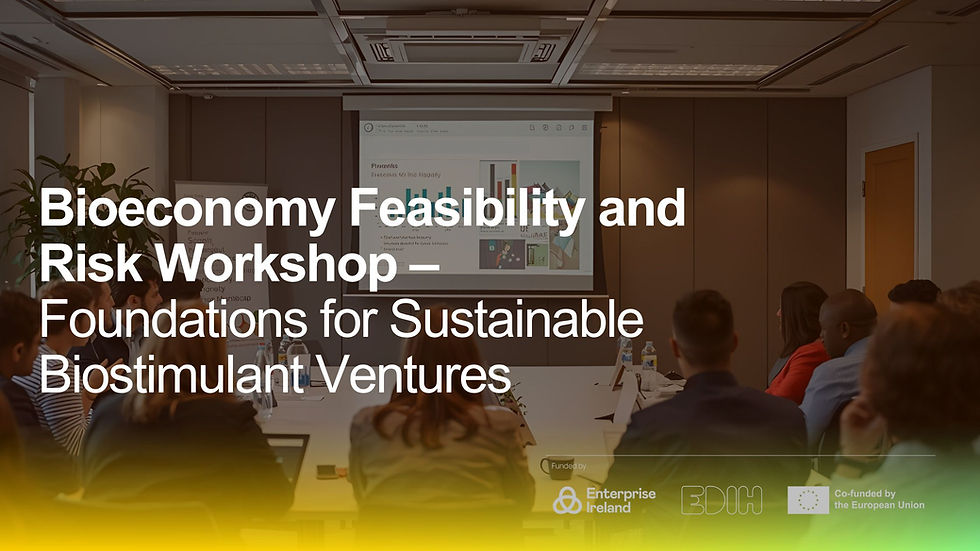
Bioeconomy Feasibility and Risk Workshop – Foundations for Sustainable Biostimulant Ventures
Wed, Dec 10
|Killybegs Energy
This workshop provides companies with a roadmap for evaluating & structuring new venture in the bioeconomy, focusing on early-stage risk & feasibility. [Rescheduled to 16 Dec 2025]
Time & Location
Dec 10, 2025, 9:00 AM – 5:00 PM GMT
Killybegs Energy, Carricknamoghil, Co. Donegal, F94 HA21, Ireland
About the Event
The Bioeconomy Feasibility and Risk Workshop is a practical, industry-focused event designed to help companies understand how to scope, assess, and de-risk new ventures in sustainable manufacturing.
Targeted at firms exploring the valorisation of high-value organic by-products — such as pot ale, bakery residues, or seaweed waste — this workshop provides the essential frameworks to ensure projects are both economically and environmentally sound.
♦️Please Note: The event has been rescheduled to 16 December 2025.
Purpose and Scope
The workshop addresses a critical need within Ireland’s circular economy: enabling organisations to move from concept to actionable feasibility. Many companies generate organic by-products with potential for reuse but lack the technical, economic, and regulatory clarity to convert them into commercial opportunities.
This event bridges that gap by presenting structured, step-by-step methods for feasibility evaluation, risk assessment, and data preparation.
What You Will Gain
Workshop Materials and Outputs
Handbook: A concise guide summarising feasibility frameworks, risk management, and compliance pathways.
Templates and Checklists: Practical tools for CAPEX/OPEX modelling, risk mapping, and traceability setup.
Reference Guide: A quick-access overview of regulatory and environmental compliance requirements.
Worked Examples: Simplified case scenarios to demonstrate how the tools can be applied.
Learning Outcomes After the session, participants will be able to:
Define the key stages of a feasibility study for bio-based ventures.
Recognise the legislative and quality requirements governing sustainable manufacturing.
Develop preliminary costing, risk, and compliance documentation.
Identify data needs and design early monitoring systems.
Strategically position their organisation to pursue circular-economy opportunities with confidence.
What to Expect
Core Topics Covered:
Feasibility and Cost Assessment Participants learn to evaluate resource availability, technical scalability, and financial viability. Templates for CAPEX/OPEX estimation, market valuation, and sensitivity testing will be introduced to guide realistic project scoping.
Process and Technical Considerations An overview of processing technologies—drying, blending, stabilisation, and fermentation—will be presented, focusing on how to handle variable biogenic feedstocks while maintaining consistent quality and performance.
Regulation and Compliance The workshop outlines the legislative landscape, including the EU Fertilising Products Regulation (EU 2019/1009), Waste Framework Directive, and Irish EPA requirements. Participants will understand what documentation, traceability, and safety measures are necessary for regulatory compliance and product legitimacy.
Risk and Liability Management A framework for building a preliminary risk register will be shared, addressing environmental, operational, and reputational risks. ISO-based risk principles will be demonstrated to help businesses manage uncertainty effectively.
Data and Quality Planning Attendees will receive templates for data capture, feedstock characterisation, and process tracking. These tools help ensure that future product development is supported by robust, traceable, and quality-assured data.
Circular-Economy and Valorisation Pathways Participants will learn how to identify industrial symbiosis opportunities, evaluate potential gate-fee or payment models for by-product sourcing, and quantify environmental benefits such as waste diversion and reduced emissions.
Who Should Attend
The event is designed for
Manufacturing & Process Engineers: Interested in the design & evaluation of sustainable production systems using variable bio-based inputs.
Environmental Managers: Seeking clarity on the EU Fertilising Products Regulation, EPA licensing, and traceability documentation.
R&D Managers: Exploring bio-based diversification
SME Owners in Food, Beverage or Agri sector: Looking for cost[1]effective, regulatory-compliant methods of valorising organic residues
Agenda
09:00 – 09:30 | Registration and Welcome Coffee
· Participant introductions
· Overview of Ireland’s emerging bioeconomy
09:30 – 10:30 | Session 1 – Understanding Feasibility and Opportunity
· Identifying potential bio-based ventures
· CAPEX/OPEX structures and feasibility templates
10:30 – 11:15 | Session 2 – Process and Technical Considerations
· Overview of key processing technologies
· Feedstock variability and scalability
11:15 – 11:30 | Coffee Break
11:30 – 12:30 | Session 3 – Regulation and Compliance
· EU Fertilising Products Regulation and EPA frameworks
· Documentation and traceability systems
12:30 – 13:30 | Lunch Break
13:30 – 14:30 | Session 4 – Risk Identification and Management
· Constructing a risk registry
· Managing environmental, safety, and reputational risks
14:30 – 15:15 | Session 5 – Circular Economy and Valorisation Pathways
· Mapping waste-to-value opportunities
· Quantifying environmental and economic benefits
15:15 – 15:30 | Coffee Break
15:30 – 16:30 | Session 6 – Data and Quality Planning Frameworks
· Feedstock characterisation templates
· Data management and traceability design
16:30 – 17:00 | Closing Discussion and Participant Q&A
· Review of key tools and takeaways
· Next steps for implementation within participants’ organisations
Registration
Please register your interest below.
Tickets
BioEconomy Workshop Ticket
The workshop addresses a critical need within Ireland’s circular economy: enabling organisations to move from concept to actionable feasibility. Many companies generate organic by-products with potential for reuse but lack the technical, economic, and regulatory clarity to convert them into commercial opportunities. This event bridges that gap by presenting structured, step-by-step methods for feasibility evaluation, risk assessment, and data preparation.
€0.00
Sale ended


